




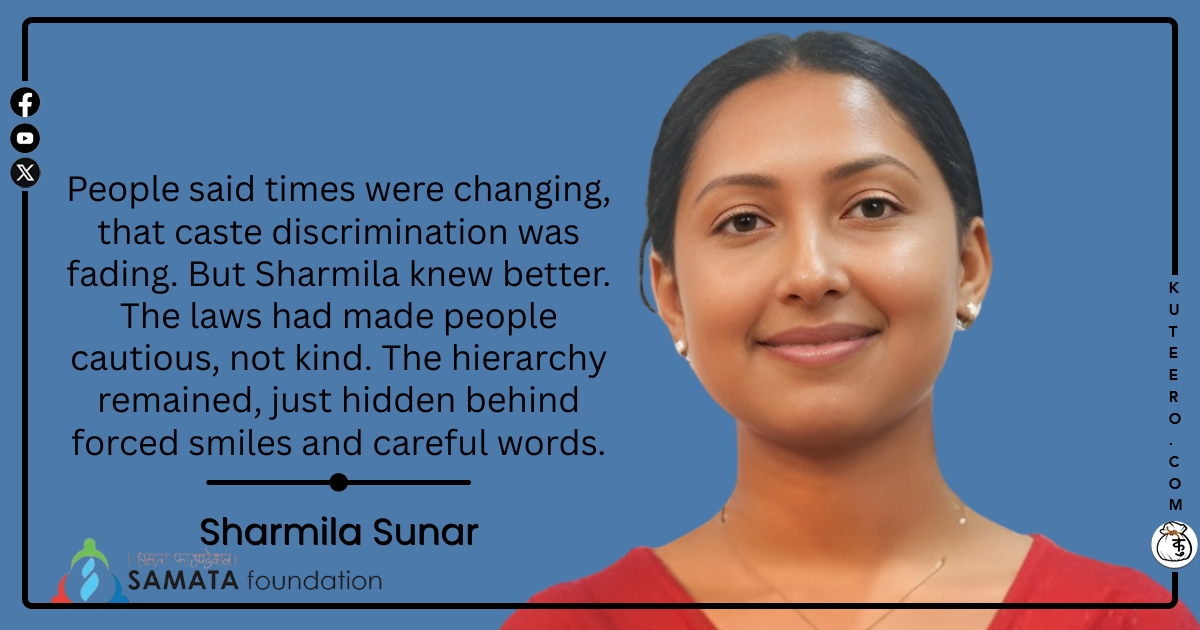

“When discrimination is hidden as tradition, it’s harder to fight. I wasn’t just denied a place to stay for my studies, I was denied dignity. But with every step toward education and self-respect, I am breaking the silence that once held me back”.
Sharmila Sunar grew up in Barahtal Gaupalika, a village in Surkhet District where most families were Dalit except for one Thakuri household. That single house stood as a constant reminder of the unspoken rules that regulated her life.
When she was in school, she could only study up to fifth grade in her village. To continue her education, she had to move to another village for classes six to ten. Many families in the new village, especially those from non-Dalit communities, completely refused to rent her a room. It wasn’t because of her character or her dedication to studies, but simply because of her caste. She ended up living with another Dalit family, and every day, walking to schoolfor an hour. People didn’t need to ask her name; they could guess her caste just by seeing where she lived. The humiliation stayed deep inside her, a quiet pain she carried everywhere.
Even with friends, she never felt truly at ease. When she went out with non-Dalit classmates, she could sense the unspoken distance, the way conversations shifted, the careful way they avoided sharing food or drinks with her. It was easier with friends from her own community. With them, she didn’t have to wonder if she was being tolerated or truly accepted.
One afternoon, when she was back from her school exhausted from the heat, she stopped at the Thakuri household and asked for water. The Thakuri lady handed her a vessel filled with water. When she was done, she watched as the woman scrubbed the vessel, rinsed it again, and left it in the sun to dry as if Sharmila’s touch had left something unclean behind.
Weddings were even harder to bear. When Dalit families had their celebrations, the Thakuri people would come but only to stand quietly and watch from a distance. They never joined in eating or the fun. Their presence felt cold and distant, like a reminder that Dalits were always outsiders.
But when Dalits were invited to Thakuri weddings, the separation was obvious. They were made to sit far away, apart from the other guests. Their food was cooked in a separate kitchen, away from where the main meal was prepared. When it was served, the plates were pushed toward them quickly, and the servers made sure not to touch them or come near. It felt less like welcoming guests and more like feeding animals. This was not by accident , it was a way to humiliate Dalits again and again, without feeling guilty about it.
People said times were changing, that caste discrimination was fading. But Sharmila knew better. The laws had made people cautious, not kind. The hierarchy remained, just hidden behind forced smiles and careful words.
She dreamed of a day when she could walk through the world without her caste trailing behind her like a shadow. Until then, she held her head high not because it was easy, but because she refused to let them win. Every time she drank from a glass without apology, every time she sat where she pleased, she was rewriting the rules. Slowly. Quietly.