





Anjali’s story shows how caste and class are intertwined. To truly challenge caste discrimination, economic inequality must also be addressed.
Anjali Basel has observed a complex reality within her community: wealth can influence how people treat Dalits. She explains that when a Dalit family is financially stable or well-off, they often experience less visible discrimination.
In fact, in her community, many Dalit families are economically stronger than some non-Dalit families. Because of this, people are less likely to openly discriminate against them.
Anjali also highlights how inter-caste marriage is shaped by class and wealth. According to her, when a Dalit individual is financially secure, other communities become more willing to accept them as marriage partners. In such cases, wealth can soften or even momentarily erase caste boundaries.
However, Anjali is very clear that caste discrimination has not disappeared. She points out that poverty and caste bias frequently reinforce each other, making life even more difficult for many Dalit families.
For those without financial security, caste-based discrimination feels harsher, deeper, and more painful. She also shares a personal reflection at times, she wonders what more she could have achieved if she were not a Dalit.
When she meets new people and they ask her name, her confidence weakens because she anticipates the judgments that may follow. This hesitation does not come from a lack of ability, but from the weight of discrimination she faces.
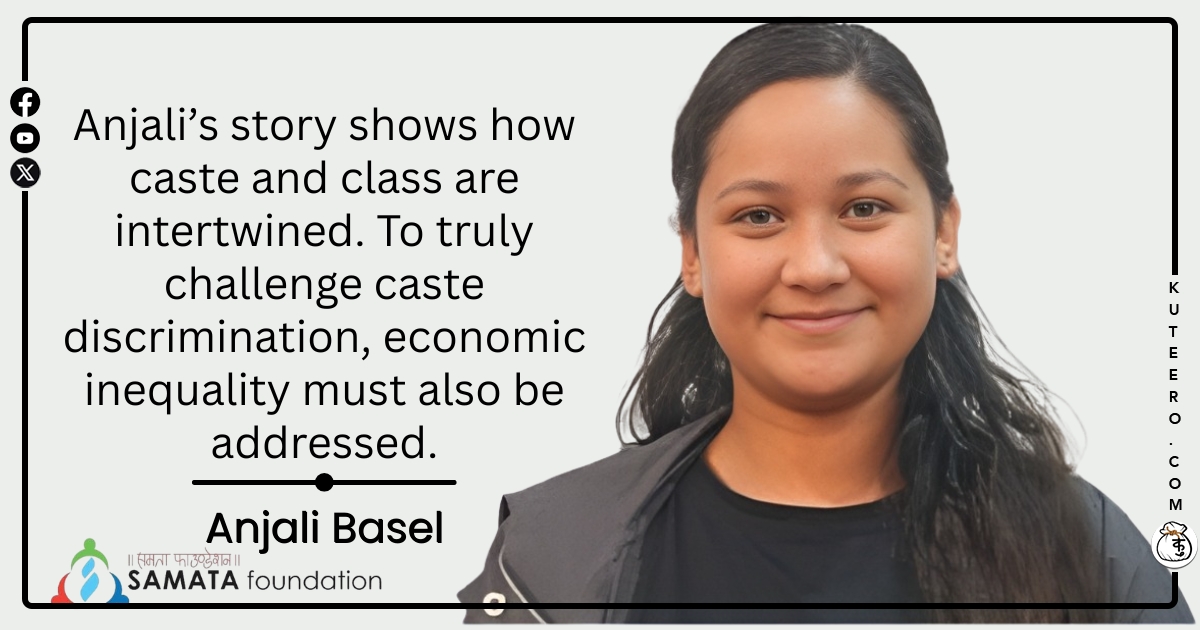
Anjali’s story shows how caste and class are intertwined. To truly challenge caste discrimination, economic inequality must also be addressed.
Her experience reminds us that real change requires confronting both poverty and long-held social prejudices.
(Anjali Basel is a Dalit human rights defender from the Samata Foundation. She is currently active in Surkhet advocating for Dalit rights and working to build an equitable society.)